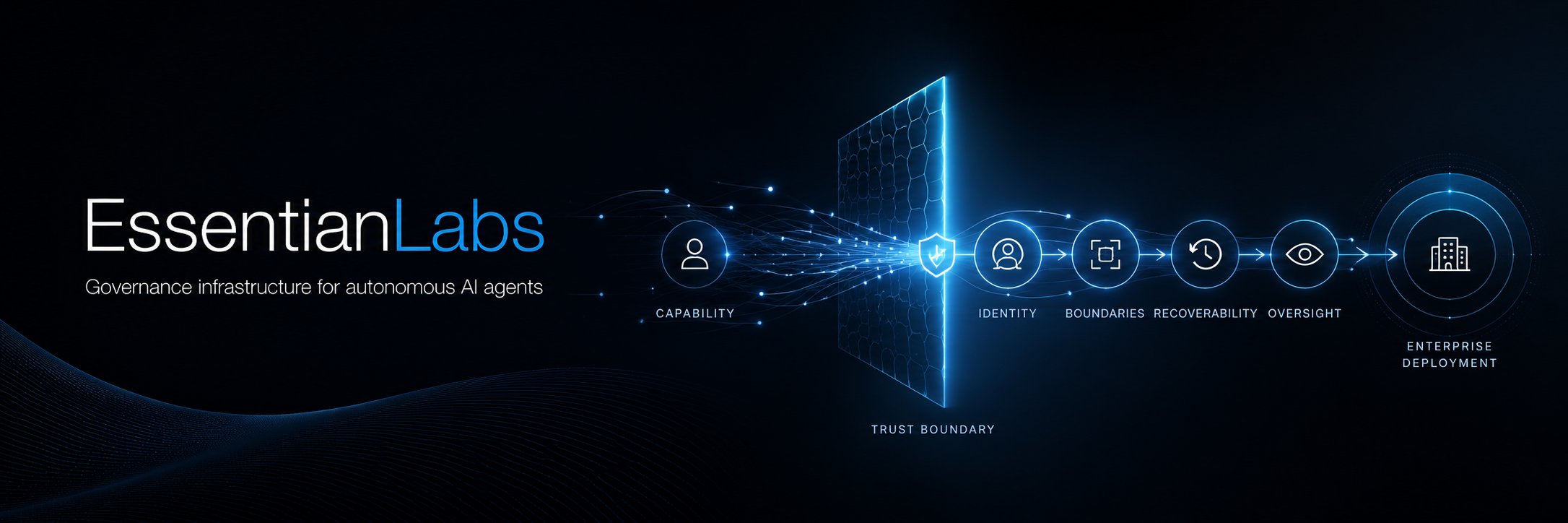
You built an agent. You still cannot take it to work.
There is no identity the organization can verify, no boundaries it can stand behind, no trail if something goes wrong. That is the wall between what people build and where it earns. EssentianLabs is building the runtime governance layer to get through it.
Every platform is promising an AI workforce. None have solved AI employability.
Picture a risk officer at a bank. Someone on her team has built an agent that drafts compliance reports cleaner than her whole team can. She cannot let it near production. Not because the drafts are wrong, but because there is no way to verify who built it, what it decided, what data it looked at, or who is answerable if it turns out to be wrong. So the agent stays on her colleague's laptop. Personal capability, no institutional presence.
Inside the organization these questions have simple names. Who authorized this action? What identity did the agent use? What was the approved scope? What evidence exists after the fact? Who can stop, reverse, or challenge it? What happens when the model changes, when the tool changes, when the business context shifts? Every one of those questions is answerable for a human employee. None of them are answerable for an agent that arrived by USB stick from someone's laptop.
The current guardrail category does not solve this. Filter-based checks bolted on afterwards catch some bad outputs, but they cannot make an organization trust an autonomous worker. What is missing is not another filter. What is missing is runtime governance: a layer designed into the way the agent operates, and portable with it wherever the owner takes it.
That is what we are building. So what someone builds at home can be deployed where it earns.
Capability without governance is just risk with a better interface.
Autonomous AI is moving from answering questions to taking action.
What used to be a question-and-answer surface is now a system that takes decisions inside real workflows, sending, spending, and changing state on the person's behalf. Every organization is quietly discovering that the controls it built for human users and deterministic software do not cover what an autonomous agent can do.
At the same time, agent capability is fragmenting across vendors, models, and tools. The stack an organization uses to run its work is no longer one thing, and it will not become one thing. Governance has to be the layer that stays coherent while everything underneath it changes.
Underneath the near-term risk question sits a longer one, about who owns the AI capability being built from human expertise. Runtime governance is the near-term product. Ownership and participation are the horizon. The first is how the second becomes possible.
Govern what an agent becomes, not only what it does.
Autonomous AI systems accumulate context and act on it. Governance has to reach both. Ours operates across three surfaces, all extracted from a coherent runtime that has been operating in production for months.
Every autonomous action gets checked before it happens. Was the agent authorized for this? Is the destination in scope? Is the reasoning coherent with the operating principles the owner set? If any check holds, the action stops, the reason is recorded, and a human decides what happens next. One layer of this is already shipped and open source: RADAR, our exit-risk assessment primitive for autonomous AI actions, MIT-licensed and available via npm.
An agent does not only act. It accumulates. Memory, judgment, habits, corrections, and trust boundaries all change the agent over time. If that state is unmanaged, the agent does not merely make isolated mistakes, it drifts. This layer governs what an agent retains, how contradictions are surfaced, what is challenged, and how what it knows is weighted and reviewed over time. Memory is not a database. It is where an agent's judgment lives.
Every held decision has a recovery surface. Every autonomous action leaves a trail. Every new agent starts inside a conversation with the person who will own it. The operator control room is where the human stays in charge: held work surfaces with the reason it was held, the operator can approve, redirect, or reject, and the runtime resumes with the decision on record. Governance should not only record what happened after the fact. It should be able to interrupt, explain, and recover the work while the agent is still operating.
All three surfaces were built to hold a real autonomous system to a real standard, inside a runtime that has been iterating in production for months. And when the agent moves, the governance moves with it. Capability is portable. Governance has to be portable too, or the trust does not follow the work.
This exists because we already built it once.
Every layer we are extracting was first designed inside Kali, an AI worker running in production with a real role, bounded authority, and governance that runs before action rather than after incident review. Not a demo. Not a Jarvis. A working system, watched carefully for what worked and what did not. We are now polishing the layers that make it possible, so anyone else can use them.
Four essays on where this is going.
Written by Karina Korpela. Published to LinkedIn.
The short version.
- What
- Governance infrastructure for autonomous AI agents. A portable layer that makes agents deployable inside organizations, not only on the machine of the person who built them.
- Why
- Because filter-based guardrails do not solve the employability problem. Organizations need identity they can verify, boundaries they can stand behind, and a trail they can recover when something goes wrong.
- How
- Runtime governance built into the way an agent operates, not bolted on afterwards. Governance at the point of action, governance of what the agent accumulates over time, and an operator surface where humans see, decide, and recover. The governance travels with the agent wherever it is deployed. One layer is already open source: RADAR, our exit-risk assessment primitive, available via npm.
- Who
- Co-founded in 2025 by Karina Korpela and Rachel Magnay. Karina brings over two decades of enterprise information security, risk, and program management, turned toward autonomous AI.
- Where
- Henley-on-Thames, Oxfordshire, United Kingdom.
- Stage
- Pre-funding. Building in the open. Runtime operating internally, individual layers being polished for external use.
If any of this resonates.
Or write directly to hello@essentianlabs.com. Operators, developers, researchers, and long-view investors welcome. We read every message.